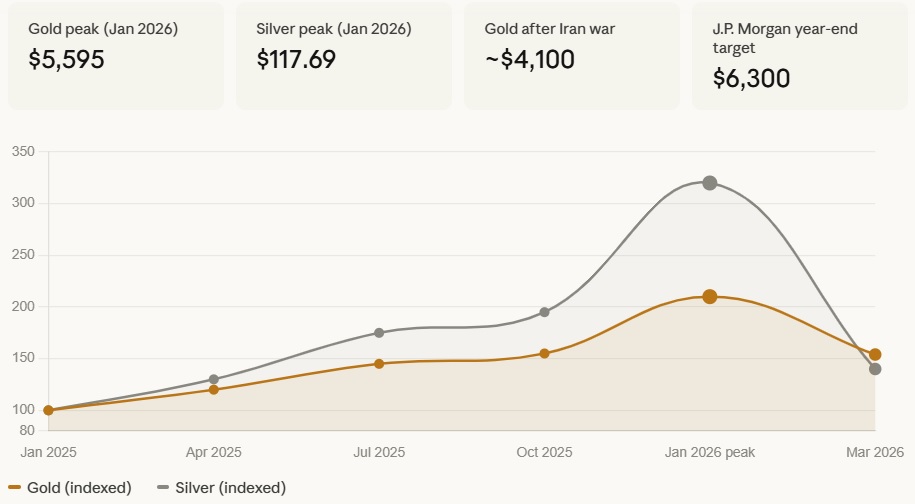
Gold and silver both enjoyed record-setting rallies in 2025, surging 66% and 135% respectively. Three forces drove this: geopolitical turbulence, a structural shift in central bank strategy, and eroding confidence in the dollar as a reserve anchor.
The central bank story is particularly significant. A 2024 World Gold Council survey found nearly 70% of central banks plan to increase their gold share over the next five years — a deliberate pivot accelerated by Russia’s frozen dollar reserves, which demonstrated that dollar assets can be sanctioned while gold cannot. This sovereign bid creates a structurally higher price floor that simply didn’t exist in previous cycles.
The January spike and the Iran war reversal
Gold punched through $5,000 for the first time in history in January, climbing to $5,595 before shedding nearly $1,200 in two days — its worst two-day rout since 1983. Silver was even wilder, partly mechanical: market makers were forced to buy silver futures to hedge short options positions, amplifying the move beyond what fundamentals warranted.
Then came the Iran war — and a counterintuitive sell-off. The surge in crude oil prices pushed up inflation expectations globally, reducing the likelihood of early Fed rate cuts and increasing the appeal of yield-bearing assets over gold and silver. Gold shed more than 20% from its peak, posting its biggest weekly drop since 1983; silver fell more than 14% in a single week and turned negative for 2026.
Gold vs. silver: not the same animal
The World Gold Council puts it plainly: gold consistently offers diversification during stress, acting as a strategic defensive asset, while silver tends to amplify moves both up and down. Silver’s volatility is roughly twice that of gold. Silver also has a split personality: it is both a monetary metal and an industrial input critical to solar panels and EVs, making it more sensitive to growth expectations than gold.
Where prices go from here
Wall Street hasn’t abandoned its bullish thesis. A Reuters poll of 30 analysts now forecasts gold at $4,746 on average for 2026 — the highest consensus in Reuters polling history. J.P. Morgan has a year-end target of $6,300; Deutsche Bank sees $6,000. For silver, Bank of America has set a $170 target while Citi forecasts $150 near-term.
The near-term headwinds are real — the Iran oil shock delays Fed cuts, the dollar has firmed, and momentum-driven retail and hedge fund money is unwinding. But the structural case remains intact: sovereign de-dollarization is a policy decision, not a trade. J.P. Morgan notes that diversification of just 0.5% of foreign U.S. asset holdings into gold would alone generate enough demand to drive prices to $6,000/oz.
The most likely path: gold consolidates in the $4,000–$4,500 range while the inflation picture from the Iran conflict clears, then resumes its climb once rate-cut expectations return. Silver follows — but with far more violent swings in both directions. For investors, gold remains the genuine safe haven; silver is a leveraged bet on gold plus a wager on the green energy economy.
Data as of March 12, 2026.
Open Your Trading Account NOW!
These materials are for information purposes only. They do not post a buy or sell recommendation for any of the financial instruments herein analysed.
Deltastock AD assumes no responsibility for errors, inaccuracies or omissions in these materials, nor shall it be liable for damages arising out of any person’s reliance upon the information on this page.
58% of retail investor accounts lose money when trading CFDs with this provider.
